LOUKIENE Kids Walkie Talkies Built for Real Outside Play
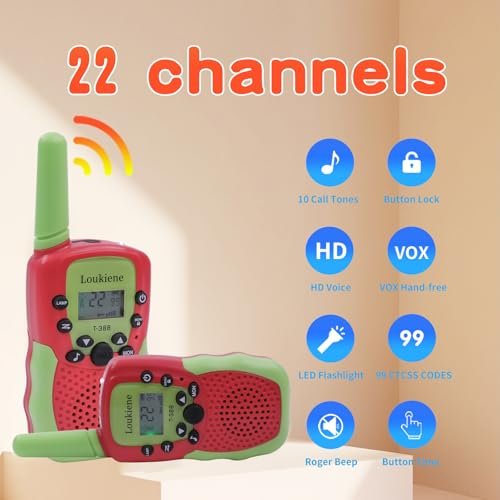
These two-way radios are made for kids 3–12 who want to actually communicate — across a campsite, between backyards, or on a hiking trail — not just pretend to. Both models run 22 channels, include a backlit LCD so kids can see what channel they're on, and carry a built-in flashlight for after-dark adventures. Parents get a keypad lock and a roger beep so nobody accidentally switches channels mid-game.

Both Models, Side by Side
Kids Walkie Talkie Pair (Red/Green)
See on Amazon
Kids Walkie Talkie Pair (Black)
See on AmazonSee more products
Discover the full product lineup with current selection on Amazon.
All products on AmazonSpec Comparison at a Glance
Both models share the same core feature set and range rating. The differences are color, battery type, and battery count — here's how they stack up directly.
| Model | Colors | Channels | Max Range | Battery Requirement | Voltage | Key Added Features | Water Resistance | Best For |
|---|---|---|---|---|---|---|---|---|
| Red/Green Set (B0GCCMRGMY) | Red & Green | 22 | 1.8 miles (open area) | 8 AAA batteries | 6V AC | Call alert, keypad lock, flashlight, roger beep, backlit LCD | Not water resistant | Younger kids who benefit from color-coded radios; families with AAA batteries on hand |
| Black Set (B0FCR3QNQJ) | Black | 22 | 1.8 miles (open area) | 6 AA batteries | 4.5V DC | Keypad lock, flashlight, roger beep, backlit LCD, noise reduction | Not water resistant | Older kids who want a less toy-like look; families who prefer AA batteries for easier resupply |
If color distinction between the two radios matters for your kids (it usually does under age 7), go Red/Green. If you'd rather stock one common battery size and want noise reduction for louder outdoor environments, the Black set is the practical pick.
How to Pick the Right Walkie Talkie Set for Your Kid
The two models in this line are nearly identical in features — 22 channels, backlit LCD, flashlight, roger beep, call alert, and keypad lock both appear across the range. The main differences come down to color choice and battery configuration, and that second point matters more than it looks.
The Red/Green set (B0GCCMRGMY) runs on 8 AAA batteries at 6V AC. The Black set (B0FCR3QNQJ) runs on 6 AA batteries at 4.5V DC. In practical terms: AA batteries are easier to find at a gas station or camp store, and many families already have a stash. AAA batteries are lighter, which matters slightly for smaller hands carrying a 3×3.5×6.5-inch radio for two hours. Neither set is rechargeable, so factor in battery supply before you leave the house.
- For camping trips: The Black set's 6 AA battery requirement is easier to resupply at a camp store than AAA. Bring a full spare set and you've got coverage for a weekend.
- For younger kids (3–6): The Red/Green color coding makes it immediately obvious which radio belongs to which child — no argument about whose is whose.
- For older kids (7–12) who want something that doesn't look like a toy: The Black set reads more like a real field radio, which matters to that age group more than parents expect.
- Keypad lock: Turn this on before handing a radio to a 4-year-old. It prevents accidental channel changes that cut communication mid-play and eliminate the "why can't I hear you?" troubleshooting session.
Both sets are rated for 1.8 miles maximum range — that figure applies to flat, open terrain with no obstacles. On a typical wooded campsite or through a row of suburban houses, expect reliable communication at 300–600 feet. That's still enough to cover a campground loop, a park block, or opposite ends of a large backyard without issue.
Real Scenarios Where These Radios Actually Get Used
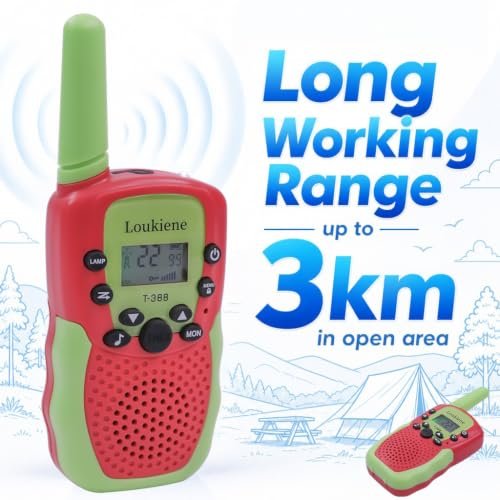
Push-to-talk is the entire interface. Hold the button, talk, release. A 5-year-old figures this out in under two minutes. The roger beep — the short tone that signals the other person has stopped talking — keeps kids from talking over each other, which is the single biggest source of frustration in kids' radio play. It functions as an audible "your turn" signal, and it works.
The built-in flashlight is worth noting as more than a feature bullet. On a camping trip, kids use the radio and flashlight as the same device when moving between tents after dark. It removes the "I lost my flashlight" problem from the equation. The backlit LCD means a child can glance down and confirm they're on channel 7 — not channel 3 — without needing an adult to help read a dark screen.
- Camping: One radio per child, matched channel pre-set before leaving the car. Range covers most standard campground sites comfortably. Parents can keep a third radio (from a compatible FRS/GMRS unit on the matching channel) to stay in the loop.
- Neighborhood play: Kids split up between houses or a park. 22 channels means you can pick a channel nobody nearby is already using, reducing the chance of interference from other radios in the area.
- Hiking with kids: One adult carries a radio, one child carries the other. The lightweight build (no weight spec provided, but the form factor is sized for kids' hands) means a 6-year-old carries it without complaint for a trail length walk.
- Sleepovers and indoor games: Range is a non-issue indoors — signal travels through standard residential walls without degradation at these distances. The call alert lets one kid ping the other without having to talk first.
One real-world note on channel selection: the 22-channel FRS format is shared with every other consumer walkie talkie sold in the US. If you're at a crowded campground where other families also have radios, you may occasionally hear someone else's conversation bleed onto your channel. Switching channels resolves this in seconds — that's what 22 options are for.
Battery Management and Care for Long-Term Use
Neither model is water resistant. That's the single most important care note for this line — and it's worth communicating clearly to kids before the first use. These radios survive normal outdoor play in dry conditions. A light rain with the radio tucked in a jacket pocket is probably fine. A dropped radio in a creek or a rainstorm with no cover is not. Keep them in a bag or pocket when weather turns.
Battery life depends entirely on how much the transmit button gets pressed. Receiving (listening) draws far less power than transmitting. In practice, a set of fresh batteries covers a full day of active outdoor play for most kids. Carry a spare set — especially for multi-day camping trips where a gas station run isn't convenient. Both models require common sizes (AAA for the Red/Green set, AA for the Black set), so restocking mid-trip is straightforward anywhere with a camp store or convenience shop.
- Before any trip: Install fresh batteries in both radios. Don't rely on batteries left in from last season — they drain slowly in storage and often fail at the worst moment.
- Keypad lock at rest: When kids set the radios down between uses, engage the keypad lock. This prevents battery drain from accidental button presses in a backpack pocket.
- Storage between seasons: Remove batteries before storing for more than a few weeks. Batteries left in electronics long-term can leak, and battery corrosion inside the housing will permanently damage the radio. A two-minute battery pull before putting them in a drawer saves the device.
- Cleaning: Wipe down with a dry cloth. No liquid cleaners — the housing is not water resistant, and moisture can work through any gap around the speaker grille or battery door.
These radios are toys in the best sense — they do what they claim, they're sized and operated simply enough for young children, and they survive the handling that comes with being handed to a kid on a trail. Treat the water resistance limitation seriously, manage batteries proactively, and they hold up through a full season of outdoor use.
Frequently Asked Questions
Does the 1.8-mile range actually work, or is that just a best-case number?
It's a best-case, open-terrain number — flat ground with no trees, buildings, or hills between the two radios. At a typical wooded campsite or through suburban houses and fences, expect reliable two-way communication at 300–600 feet. That covers a campground loop, a park block, or opposite ends of a large backyard without any trouble. The 1.8-mile figure is real, but it requires conditions most families won't encounter during normal outdoor play.
What age can actually use these — are they too complicated for a 4-year-old?
A 4-year-old can operate the core function in about two minutes: hold the button on the side to talk, release to listen. The roger beep tells them when the other person is done talking so they know when to press. The only complication is accidentally pressing other buttons and changing the channel — that's exactly what the keypad lock prevents. Engage the keypad lock before handing it to a young child and the radio stays on the right channel for the whole outing.
Can these radios communicate with other brands of walkie talkies?
Yes, in most cases. These run on the standard 22-channel FRS (Family Radio Service) format used by virtually every consumer walkie talkie sold in the US. As long as the other radio is an FRS-compatible unit set to the same channel, the two can communicate — useful if parents want to carry a different radio and stay in contact with the kids. The one caveat: interference from other families at a crowded campground using the same channel. Switching to a less-used channel among the 22 options resolves this immediately.
What's the difference between the Red/Green set and the Black set beyond color?
Three things: battery type (8 AAA versus 6 AA), voltage (6V versus 4.5V), and one added feature — the Black set includes noise reduction, which the Red/Green set doesn't list. In practice, noise reduction helps filter out wind and background sound when a child is transmitting outdoors, making the voice clearer on the receiving end. If you're buying for a camping or hiking context where wind is a factor, the Black set has an edge there. If color coding matters more (it usually does for kids under 7), the Red/Green set is the better pick.
These aren't rechargeable — how many batteries do I actually need for a weekend camping trip?
For the Red/Green set: 8 AAA per pair, so bring at least one full spare set (16 AAA total) for a two-day trip with active kids. For the Black set: 6 AA per pair, so 12 AA with a spare set of 12. Battery life varies based on how much transmitting happens — listening draws far less power than talking. A day of moderate play on fresh batteries is realistic for both sets. The AA batteries in the Black set are easier to find at camp stores and gas stations if you run short mid-trip.